English
 日本語
日本語 한국어
한국어 français
 tiếng việt
 Indonesia
 Español
 العربية
 русский
Feb 05, 2026
Blog

A paper recycling line rarely receives paper in a perfectly clean and uniform form. A single incoming load may contain loose sheets, cardboard, books, packaging, plastic film, labels, or other unwanted materials. Once these materials enter the processing line, the shredder must handle more than paper reduction—it must create a feed condition that allows screening and separation equipment to work effectively.
That is why industrial paper shredder selection should start with the waste stream rather than the machine itself. The type of paper, contamination level, feed size, required output, processing capacity, and downstream equipment all influence which shredding technology makes sense. In mixed recycling applications, the role of a solid waste separator is also closely connected to the quality and consistency of the shredded material.
This guide looks at the practical factors behind industrial paper shredder selection, from output requirements and two-shaft shredding technology to maintenance, capacity, and integration with a solid waste separator. The goal is to help recycling operators evaluate equipment based on how it will perform within the entire waste-processing line.
Blade design is an important part of an industrial paper shredder, but it should not be treated as the only indicator of performance. Industrial paper waste can vary significantly in density, moisture, size, and contamination. Loose office paper behaves differently from compressed books, corrugated cardboard, paper packaging, or paper mixed with plastics and other municipal waste.
The cutting system must therefore be matched to the material that will actually enter the machine. A shredder operating on relatively clean paper may experience a very different load profile from one processing a mixed commercial waste stream. Plastic film can wrap around components, bulky bundles can increase feeding resistance, and unexpected metal contamination can place additional stress on the cutting system.
Feed consistency is another important consideration. A machine may have a high theoretical processing capacity, but unstable feeding can prevent it from reaching that level in normal operation. For this reason, buyers should evaluate the entire material-handling process, including conveyors, hoppers, feeding mechanisms, and the condition of the material entering the cutting chamber.
Instead of asking only how many blades a machine has, a more useful evaluation considers cutting configuration, torque, feed opening, chamber dimensions, motor arrangement, expected material density, output requirements, and the downstream process.
The required output should be established before selecting shredding technology. The same paper waste can require different processing strategies depending on what happens after shredding.
For example, material intended for baling may have different size requirements from material being prepared for further screening or sorting. If shredded paper is entering a recovery line, excessive variation in particle size can make downstream classification less predictable. If the material is being prepared for another industrial application, the acceptable output characteristics may be different again.
Output requirements also affect the selection of downstream equipment. A solid waste separator needs a reasonably suitable material feed to perform its intended separation function. If the shredder produces too many oversized pieces, the separator may have difficulty processing the stream consistently. If the material is reduced excessively, useful fractions may become harder to recover.
For that reason, the objective is not necessarily to make the paper as small as possible. The better objective is to produce an output that meets the requirements of the next processing stage.
Feed preparation should be considered at the same time. Large bundles, compacted paper, wet material, and contamination can all affect the mechanical load placed on the shredder. When defining specifications, it is more useful to describe the actual incoming material than to use a generic term such as “paper waste.”
For businesses comparing available equipment, Yuebang's products provide a starting point for reviewing solid waste processing equipment and considering how shredding and separation technologies can fit into a complete material-processing system.
Two-shaft shredders use two counter-rotating shafts equipped with cutting elements. The shafts draw incoming material into the cutting chamber, where the cutters grip, tear, and progressively reduce it. This feeding action can be useful when the waste is bulky, irregular, or difficult to handle with a simple high-speed cutting approach.
For mixed paper waste, the ability to actively pull material into the cutting chamber can help accommodate materials such as books, cardboard, packaging, and other paper-containing products. This is particularly relevant in commercial and municipal waste streams where incoming materials are unlikely to have uniform dimensions.
Two-shaft technology can also provide a useful primary size-reduction stage before screening or separation. The objective at this stage is usually to open up and reduce the incoming material sufficiently for subsequent processing, rather than to achieve an extremely fine and uniform final particle size in a single operation.
That distinction matters when selecting equipment. A two-shaft shredder is not automatically the best option for every paper application. If the required output is very fine or highly uniform, secondary shredding, screening, or other size-control equipment may be necessary.
The most suitable configuration depends on the relationship between the feed material, required throughput, target output, and downstream processing stages.
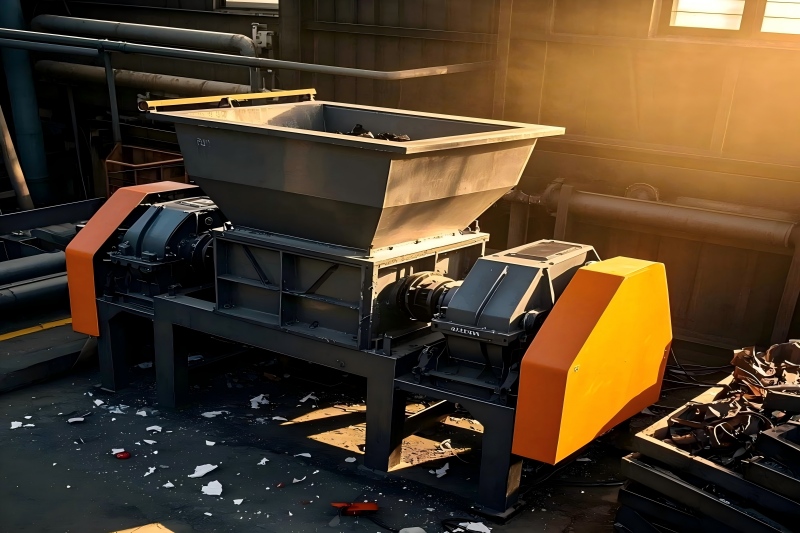
In a commercial or municipal recycling environment, paper is often only one component of the incoming waste. The material may also contain cardboard, plastics, textiles, packaging components, wood pieces, and metals. As a result, the shredding stage needs to be considered as part of a broader processing line.
A typical system may include feeding equipment, primary shredding, conveyors, screening, magnetic separation, material classification, recovery, and final compaction. The exact arrangement depends on the composition of the waste and the desired recovered products.
This is where a solid waste separator can become an important part of the process. After the shredder has reduced the overall size of the incoming material, separation equipment can help divide the stream into fractions according to physical properties such as size, density, or magnetic response.
A solid waste separator does not replace the shredder. Instead, the two technologies perform different functions. The shredder changes the physical size and structure of the waste, while the separation stage focuses on classifying or recovering different material fractions.
For example, ferrous metals may be recovered through magnetic separation, while other fractions may require mechanical screening or air-based classification. The appropriate technology depends on the composition of the incoming waste and the recovery targets.
Shredding and separation should therefore be designed together. If the shredder output is poorly matched to the separator, the downstream stage may experience reduced efficiency or unstable material flow. A properly selected solid waste separator should receive a feed that is compatible with its operating principle and intended separation range.
This systems-level approach can also help prevent unnecessary size reduction. Producing smaller particles does not automatically mean producing a better recycling feed. The desired output should be determined by what the next stage actually needs.
Capacity is one of the first specifications buyers usually compare, but advertised throughput needs to be interpreted carefully. Actual processing rates can change with material density, moisture, contamination, feed consistency, particle size, and feeding method.
For example, a relatively light stream of loose paper may behave differently from densely packed books or cardboard-heavy waste. A mixed stream containing difficult contaminants can also place a higher mechanical load on the cutting system.
When comparing capacity, ask whether the quoted figure applies to the same type of material that will be processed at the intended facility. A realistic equipment evaluation should focus on expected operating conditions rather than a theoretical maximum alone.
Feed opening dimensions are equally important. If incoming material must be extensively reduced before entering the shredder, additional labor or pre-processing equipment may be required. An appropriately sized feed opening can simplify material handling and improve the consistency of the shredding process.
Maintenance should be considered before the machine is installed. Operators need practical access to cutting components, inspection areas, lubrication points, and other service locations. Wear parts should also be replaceable without creating unnecessary downtime.
Safety is another fundamental part of industrial shredder selection. Guards, emergency stopping systems, access controls, electrical protection, maintenance procedures, and safe feeding arrangements should all be incorporated into the equipment and plant design. These requirements should be reviewed according to the applicable regulations and standards for the installation location.
A reliable industrial paper shredder is ultimately one that can maintain predictable operation while remaining serviceable and safe under the conditions for which it was selected.
A supplier comparison should focus on how well each proposed system matches the actual application. Looking at motor power alone is unlikely to provide enough information for a meaningful decision.
| Factor | What to Evaluate | Why It Matters |
|---|---|---|
| Feed material | Paper type, cardboard content, moisture, contamination, and bulk density | Determines the mechanical demands placed on the shredder |
| Cutting configuration | Two-shaft or other suitable shredding technology | Influences feeding behavior, cutting action, and output characteristics |
| Feed opening | Opening dimensions relative to incoming material | Can reduce unnecessary pre-processing and improve feeding efficiency |
| Output requirements | Target particle size and acceptable size variation | Determines compatibility with screening, separation, baling, or further processing |
| Throughput | Expected processing rate under actual material conditions | Provides a realistic basis for equipment sizing and production planning |
| Maintenance | Access to cutting parts, inspection areas, lubrication, and wear components | Influences uptime and long-term operating costs |
| Line integration | Compatibility with conveyors, screens, magnets, and a solid waste separator | Helps maintain continuous and controlled material flow |
Testing representative material can be particularly useful when the waste stream is complex. A sample test may help determine how the machine handles actual feed dimensions, contamination, moisture, and material density. It can also provide a clearer understanding of the resulting output and whether additional screening or a solid waste separator is required.
Buyers should also examine the supplier's ability to explain the engineering basis for its recommendation. A useful technical discussion should cover the expected waste characteristics, proposed equipment configuration, output requirements, maintenance considerations, and integration with the rest of the processing line.
Yuebang can be considered as part of this equipment evaluation process. Its solid waste processing equipment can be reviewed according to the requirements of a particular application rather than selected solely from headline specifications. For projects involving mixed paper waste, separation requirements, or complete processing-line considerations, businesses can contact Yuebang to discuss the intended application and equipment requirements.
Choosing an industrial paper shredder is fundamentally a process-design decision. The right equipment depends on what enters the machine, what output is required, and what happens after shredding. Feed composition, contamination, material density, cutting configuration, feed opening, throughput, maintenance, and safety all need to be evaluated together.
For mixed recycling applications, shredding is only one stage of material preparation. Screening and separation can determine how effectively different fractions are recovered after size reduction. A properly selected solid waste separator can therefore play an important role when paper is processed together with other solid waste materials.
The most practical approach is to define the waste stream first, establish the required output, compare equipment against real operating conditions, and consider the complete processing line rather than a single machine. When the shredder and solid waste separator are selected as complementary stages, the resulting system can provide a more controlled material flow and a stronger foundation for efficient waste processing.
An industrial paper shredder is heavy-duty size-reduction equipment designed to process large volumes of paper and paper-containing waste. Depending on its configuration, it can also handle cardboard and other materials found in commercial or municipal waste streams.
A two-shaft shredder uses counter-rotating cutting shafts to grip and tear incoming material. This feeding action can be useful for bulky, irregular, or mixed paper waste that is difficult to feed consistently.
Consider the actual feed material, contamination, moisture, feed size, required output, expected throughput, cutting configuration, maintenance requirements, safety features, and compatibility with downstream equipment.
A solid waste separator is equipment used to classify or separate processed waste into different material fractions. Depending on the system, separation may use size, density, magnetic properties, airflow, or other physical characteristics.
No. A solid waste separator is mainly relevant when the shredded stream contains different materials that need to be classified or recovered separately. Clean paper-only applications may have simpler downstream requirements.
Start with the expected material type, bulk density, feeding conditions, operating schedule, and required output. Supplier capacity figures should be evaluated against representative material rather than treated as universal performance values.